Wolbachia
NEA Project
Wolbachia is an extremely common bacteria that occur naturally in 50 per cent of insect species, including some mosquitoes, fruit flies, moths, dragonflies and butterflies.
Wolbachia is safe for humans and the environment. Independent risk analyses indicate that the release of Wolbachia-infected mosquitoes poses negligible risk to humans and the environment.
Wolbachia live inside insect cells and are passed from one generation to the next through an insect’s eggs. Aedes aegypti mosquitoes don’t normally carry Wolbachia, however many other mosquitoes do.
Final render
Color Material Finishing
Sketches
Final render
%20(1).png)
%20(1).png)
%20(1).png)
%20(1).png)
%20(1).png)
Releasing container
These are the development sketches. The major feedback given by users is to minimize the height, larger the capacity, enhance invisibility and rectangle knot.

other products
Storyboard
Rel-ease
Generally, we as a team need to design a group of eco-system products that aims to help the field team and lab team have a better experience throughout the preparation, release and collection process. The products are included with the releasing container, assistant pole, container carrier and attachment.


Research
This time was the first time that we were working with real clients. Therefore, there will be a lot of site visits in the lab and release locations. Subsequently, we could gain insights from the users, environment and equipment. As such, the clients will regularly provide feedback to us and improve our product further.


This time was the first time that we were working with real clients. Therefore, there will be a lot of site visits in the lab and release locations. Subsequently, we could gain insights from the users, environment and equipment. As such, the clients will regularly provide feedback to us and improve our product further.
Design Statement
After consolidating the insights and consideration from our research, we have design an ecosystem of product to Maximise working efficiency The success rate in rearing and Releasing Wolbachia mosquitoes

The Releasing container will be used to release the pupa at the HDB block, and the container will be attached to the wall to prevent damage. Design criteria for containers are to minimise tampering, maximise efficiency and prevent leakage.

Family sketch & Render
After a few around of refinement of the products, we have locked down to this final family concept and we have rendered it in Rhino.


What features the container has are Easy pupae transferring Convenient Easy corporation invisible Secure usage


For the container design, there are three sections at the top: releasing, locking, and filling, used for different situations. And the mesh at the side can filter out extra water to ensure the water is at standard level. also, the rectangle knot can secure its position when slotting.
follow up with the refined water tank which can hold the container securely and accurately when filling puape.


Color Material Finishing
The other three products are assistant pole, attachment and carrier. They are all designed by my teammates.


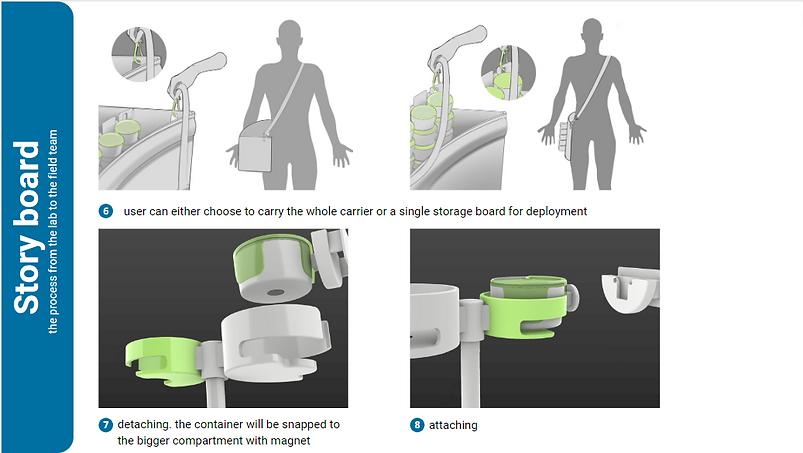
The pole design helps detach the container more efficiently by increasing the volume and capacity of the holder, which allows for catching the container easily. Furthermore, the magnet aims and secures the container when detaching. For attachment, it can grab the container securely and hang it smoothly on the wall.


I drew the storyboard in a manga style that is more pleasant and attractive for the reader to read. Moreover, it is also a cheaper but more efficient way to elaborate on the user journey by using sketching.

The user needs to turn the top of the container to the pupae filling section and put it in the water tank. and start filling up water and pupae. Extra water will flow out from the side mesh and goes back to the machine.
then lock the container by turning the top, and slot it into the carrier.
next, turn the top to the release section and be ready to attach
Users can either choose to carry the whole carrier or a single storage board for development. and last will be the process of detaching and attaching.